The B-string of a guitar is made of steel (density 7800 kg/m 3 ), is 63.5 cm long, and has diameter 0.406 mm. The fundamental frequency is f = 247.0 Hz.
 f if the temperature of the string rises to 29.5ºC. The steel string has a Young's modulus of 2.00 × 10 11 Pa and a coefficient of linear expansion of 1.20 × 10 –5 (Cº) –1 . Assume that the temperature of the body of the guitar remains constant. Will the vibration frequency rise or fall? [Out of Tune]
 F, the frequency f changes by a small amount
  f. Show that
  =
= 

Text Solution
Verified by ExpertsCHECK THE SOLUTION.
For a string, f n = 
 and in this case, n = 1. Rearranging this and solving for F gives
F = µ4L 2 f 2 . Note that µ = 𝜋 r 2 ρ,
so µ = 𝜋 (0.203 × 10 –3 m) 2 (7800 kg/m 3 ) = 1.01 × 10 –3 kg/m. Substituting values, d
F = (1.01 × 10 –3 kg/m) 4(0.635 m) 2 (247.0 Hz) 2 = 99.4 N.
To find the fractional change in the frequency we must take the ration of  f to f:

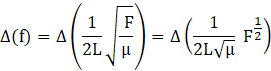
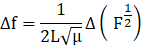
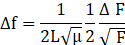
Now divide both sides by the original equation for f and cancel terms:
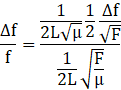

From Section 17.4,  F = – YαA
  T, so
T, so
 F = –(2.00 × 10 11 Pa)(1.20 × 10 –5 /Cº) × ( 𝜋 (0.203 × 10 –3 m) 2 )(11ºC) = 3.4 N. Then,
  F/F = – 0.034,
  f/f = – 0.017, and finally,
  f = –4.2 Hz, or the pitch falls. This also explains the constant the constant tuning in the string sections of symphonic orchestras.
Prepare Smarter with CGP Edu
Get practice questions, solutions, and test series in one place.
Write a Review
Share your experience with this question and solution.
Commentary
Send your comment, doubt, correction, or feedback to admin.
Similar Questions
Explore conceptually related problems